Search This Blog

Showing posts with label 60's. Show all posts

Sunday, December 30, 2012

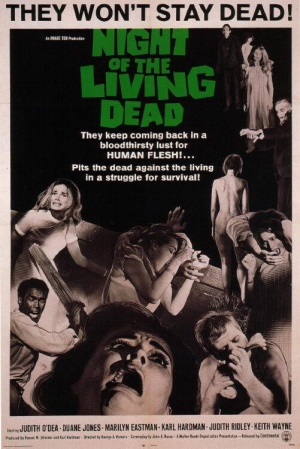
Day 365: Night Of The Living Dead
Night Of The Living Dead
Good night and good luck

This is it. The end. The 365th movie review. They said it couldn't be done. I didn't even think I would make it this far, but we made it. I've seen movies about vampires, werewolves, monsters, animals, serial killers, aliens, killer clowns, ghosts, demons, Satan, and my favorite, zombies. I have seen classics, independents, movies I've always wanted to see, and movies I wish I had not. I will be taking a much needed break in the coming days, but I will be doing at least a few more posts, which will include a “Best Of” awards ceremony and Razzies for the worst. I want to personally thank each and every one of you for helping me, whether it was procuring certain movies, helping me with research, correcting some mistakes, and spreading the word. Without you, I would have stopped a long time ago. Without further ado, here is the final review for 365 Days Of Horror.

Night Of The Living Dead is a 1968 zombie movie written and directed by George Romero (Dawn Of The Dead, Creepshow). The movie stars Judith O'Dea (The Pirate, The Ocean) as Barbra and Duane Jones (Vampires, To Die For) as Ben. Barbra and her brother Johnny (Russell Streiner, The Majorettes, Night Of The Living Dead 1990) drive to rural Pennsylvania to visit their father's grave. Johnny is annoyed to be there and entertains himself by teasing Barbra. He playfully chases Barbra, pointing to another man in the cemetery and warning, “They're coming to get you, Barbra!” The man, a zombie, attacks Barbra and then struggles with Johnny who cracks his head on a gravestone. The man chases Barbra to her car and smashes the window with a rock before she is able to pull the emergency break and roll down a hill. The car crashes and Barbra flees to a nearby farmhouse where she discovers a decomposing body upstairs. When she leaves the house, she is surrounded by zombies and is saved by a man named Ben who brings her back inside. Barbra is traumatized by the events and goes into shock while Ben tries to secure the house by boarding up the doors and windows. It is revealed that a group of people have been hiding in the house's cellar the entire time. The group is made up of a young couple named Tom (Keith Wayne) and Judy (Judith Ridley) as well as Harry Cooper (Karl Hardman, Santa Claws) his wife Helen (Kyra Schon) and their daughter, Karen, who has been bitten by a zombie. The cowardly Harry tries to explain why he did not help Ben when he heard him upstairs, but Ben does not believe him. Harry insists that they are safer in the cellar, but Ben rebuffs him, claiming it is a “death trap”. While Harry and his family stay in the cellar, the rest of the group listens to the radio and television for information. The problem is widespread across the entire East Coast and the murderers, who appear to be the recently deceased, are cannibalizing their victims. While there is no definite explanation, it is believed that a space probe returning from Venus that exploded in the Earth's atmosphere may have been contaminated with radiation. A news report reveals that a rescue center has been established nearby and, with the farmhouse becoming increasingly surrounded by the undead, the group agrees to make a run for it. Ben, Tom, and Judy make a run for a truck near the house while Harry throws molotov cocktails at the zombies. Tom accidentally spills fuel on the truck, causing it to eventually explode, killing himself and Judy. Ben runs back to the house, but is unable to enter because Harry refuses to unlock the door. Ben is forced to break down the down, and after securing it, assaults Harry. Harry threatens to shot him, but Ben takes his gun and shoots Harry, who stumbles down the cellar. With the plan failing and zombies surrounding the house, how will Ben and Barbra survive?

Welcome to the gun show

Night Of The Living Dead is the movie to which all other zombie movies are compared. While there were zombie movies previous to this one, like White Zombie and King Of The Zombies, Night Of The Living Dead set the standard for the modern zombie films. George Romero crafted a horror movie that is both smart and graphic, appealing to all types of horror fans. The combination of suspense, thrills, and action makes the movie an intense and gut-wrenching experience. The movie's graphic nature was shocking at the time as we see the zombies tearing at and eating human body parts. Before NOTLD, most zombies were simply the product of voodoo and mind control. Romero created zombies that are far scarier with added aspect of cannibalism. They are violent monsters with an insatiable hunger and virtually limitless numbers. Despite being in black and white, the movie is still quite gory and bloody, especially for a movie in the 1960's. The movie cleverly leaks out bits of information about what is happening, putting the audience in the same position as the characters, causing us to relate to them. By doing this, we learn why there are zombies and how to stop them. We also learn that armed posses are combing the area, a foreshadowing of things to come.

"Oh, tombstone. You're such a great hugger."

More importantly, though, the zombies in Night Of The Living Dead are not the true monsters. As is now common among Romero and other zombie movies, social commentary is in full effect. Romero's casting of a black man in the hero role was seen as slightly controversial at the time. By doing so, the audience is forced to deal with their own personal feelings of prejudice and race. This is one of the main themes of the movie as hatred, mistrust, and deceit are all at work in the movie. Harry is a coward who is clearly out of his element, but refuses to listen to Ben, despite clearly being in control. Harry thought the best idea was to hide and hope for the best while Ben is proactive, boarding up the house and getting the radio and television to work. We all hope to be brave like Ben, but we secretly fear that at the moment of truth, we may be more like Harry. It was disappointed that Barbra was virtually useless for most of the movie and even Romero himself has stated that he was unhappy with the way she was written. The acting is good all around which helps make the movie emotional and believable. 

These flash mobs are ridiculous

Night Of The Living Dead was George Romero's feature-length directorial debut, but you would never know it. Scenes are shot with a competent confidence with a mixture of interesting angles that help convey a sense of frantic horror. The film opens up like any normal event, but quickly disintegrates into an uncontrollable horror that never ens. Less than ten minutes is all it takes for the movie to become a dire struggle for survival. Rather than having the movie take place in an easily recognizable area, Night Of The Living Dead takes place in a rural area that could be just about anywhere. Shot in central Pennsylvania, the natural open setting is all the more terrifying because it appears to be calm and comforting. The movie has a good amount of action and scares that still make modern audiences jump. The musical flourishes are great and make certain scenes far scarier than one would initially expect.

"Hey, put Cougar Town on."

Night Of The Living Dead was not the first zombie movie, but it did manage to completely change the genre. Bland mind-controlled zombies were replaced by the living dead who's only motivation is to feed on the living. The movie established new rules, like shooting zombies in the head, that are still followed to this day. The movie is shockingly violent and gory, still capable of scaring modern audiences. The story is great from the intense and frantic beginning to the brutal, depressing ending. The movie is full of important social commentary that still resonates today. The acting is great and Romero's direction is perfect. Whether you're looking for a straight-forward and scary horror film, or a smart, thoughtful movie with lots of action, Night Of The Living Dead is an all-encompassing and entertaining movie. There is a reason why the Library of Congress selected it for preservation in the National Film Registry. Unfortunately for Romero, but fortunately for you, the movie entertained the public domain because the original distributor, the Walter Reade Organization, did not put a copyright on prints of the film. The movie is now available through many different mediums, including for free on various websites. Night Of The Living Dead is an incredibly entertaining and incredibly important movie. Aspiring film makers, writers, and actors should watch the film as a blueprint for making a great movie on a limited budget. As for horror fans, it's required viewing. A movie like Night Of The Living Dead makes horror fans proud of the genre they love.

10/10

Tuesday, December 4, 2012

Day 339: The Dunwich Horror

The Dunwich Horror
I like my Dunwich with the crusts cut off

Why? Why is it so hard for Hollywood to make a good H.P. Lovecraft movie? The stories are there. The built-in audience is there. The merchandise is there. Just get a competent director and actors who can talk without accidentally swallowing your tongue and you're halfway there. Hollywood managed to crank out plenty of Harry Potter and Twilight movies, but we can't get a good “Beyond The Wall Of Sleep” “The Shadow Over Innsmouth” or “Cool Air”? We're getting a freaking 50 Shades Of Grey movie faster than At The Mountains Of Madness. I've reviewed a few Lovecraft-based movies and for the most part, they've been terrible. Like riding a bicycle, sometimes you just have to keep trying with horror, so I might as well try with The Dunwich Horror.

The Dunwich Horror is a 1970 horror movie starring Dean Stockwell (Air Force One, The Langoliers) as Wilbur Whateley and Sandra Dee (Come September, Rose!) as Nancy Wagner. At Miskatonic University in Arkham, Massachussetts, Dr. Armitage (Ed Begley, Sweet Bird Of Youth, 12 Angry Men) is giving a lecture on local history and the very rare book The Necronomicon. He gives the priceless book to his student Nancy Wagner who is to lock it up in the school library. There she meets Wilbur Whateley who asks to see it before she puts it away. His hypnotic gaze overcomes Nancy allowing him to look through the book and discover a certain passage. Dr. Armitage catches him, but Wilbur's gaze also overtakes the doctor and all three end up having dinner together. Nancy, still under Wilbur's power, agrees to drive him to his home in Dunwich where he disables her car, forcing her to stay overnight. At the house, Nancy encounters the strange Old Whateley, Wilbur's grandfather, who warns her that she should not be in the house. When Nancy is not found the next day, Armitage and her friend Elizabeth find her at the Whateley home. Nancy refuses to leave, saying she wants to stay with Wilbur for the weekend. Armitage begins to investigate Wilbur and discovers that his mother Lavinia is still alive and currently living in an asylum. She actually had twins, but apparently one was stillborn. The father was unknown and the birth was so painful and traumatic that Lavinia lost her mind. It is revealed that Wilbur plans to use Nancy in a cult ceremony that would bring the Old Gods back to our dimension. Will Dr. Armitage be able to stop him and what exactly lives in the locked room of the Whateley house?

"Soon, Justin Bieber....very soon!"

Holy crap on crust was this bad. My love of Lovecraft's work is no secret. I even visited his grave at the fantastic Swan Point Cemetary in Providence, Rhode Island. I really enjoy his short story “The Dunwich Horror” and was hoping that the movie would be able to do it justice. While the movie does retain some of the names and some plot details, there's very little connecting it to the story. Instead of mystery, intrigue, and a dark, creeping atmosphere, we get a B-movie with bad acting, goofy special effects, and extended sexuality. It all makes sense when you see that one of the producers was Roger Corman, the king of schlock. I understand that stories need to be tweaked and adjusted for the big screen, but The Dunwich Horror creates the Nancy character and goes off in a completely different direction. Gone are the Lovecraftian touches of horror, replaced with a story that doesn't really go anywhere and super-cheap special effects. We get a multi-colored strobe effect that washes over entire scenes. The first few times it was kind of neat, but then it kept happening. And happening. And happening. It was harsh on the eyes and just plain annoying. When we finally see what is in the locked room it looks like it fell off the set of H.R. Puffinstuff.

It doesn't help the movie that the acting is especially bad. Dean Stockwell gives an awkward, sweaty performance that makes me want to register him as a sex offender. He gives creepier stares than that guy in his 40's going to high school basketball games by himself. Sandra Dee isn't given much to work with as she's essentially hypnotized for most of the film. This was Ed Begley's last film which is a shame. He does his best, but it's just not enough. The direction is shoddy at times and the camerawork could have been better. There is a fight scene in the library that had to have been done in one take it's so bad. Combine the bad fighting with absolutely no music and it's just a trainwreck of epic proportions. Nothing in the movie is scary (well beyond Dena Stockwell's molester stare) which is too bad because Lovecraft can be quite terrifying.

"So...my cult or yours?"

Lovecraft fans will be disappointed with The Dunwich Horror. Hell, horror fans will be disappointed with with The Dunwich Horror. The story only retains a few details from the original story and some basic plot points. The acting is not good and makes the bad story even worse. There is a serious lack of atmosphere or any real horror, replaced by 1960's sex and psychedelia. It also doesn't help that the movie is supposed to take place in Massachusetts, but it's clearly shot in California. It's unintentionally funny and certainly different from a typical movie at the time. If you're morbidly curious, check it out, but if you're looking for a good movie, stay far away.

2/10

Thursday, November 29, 2012

Day 334: Onibaba

Onibaba
Where's Giant Baba?

And now for something completely different. When you plan to watch over 300 horror movies, you start to run out of movies you want to see. It's not like there's a shortage of horror movies out there, it's just that there's only so many good ones to go around. I've checked off many classics and must-sees on my list and there's a few more outstanding ones still to be watched. I've taken to looking at “best of” to make sure I haven't missed any major movies. Most of the lists tend to have the same movies, just in different order. I did manage to find with with a slew of lesser-known European and Asian movies. Today's movie caught my eye just for being so completely different: a Japanese horror movie from the 1960's that takes place in the 14th century. Yeah, that's something different, alright.

Onibaba (translated as Demon Hag) is a 1964 historical horror drama written and directed by Kaneto Shindo (The Naked Island, Tree Without Leaves). The movie stars Nobuko Otowa (A Last Note, The Naked Island) as Older woman and Jitsuko Yoshimura (The Insect Woman, Pigs and Battleships) as Younger woman. In 14th century feudal Japan, a civil war has erupted between fiefdoms. Through the ravages of war and famine, both woman survive by killing lost soldiers who wander near their home. They hide in fields and when the soldiers come buy, they viciously stab them to death. The women strip the soldiers of their armor and weapons and trade them with a merchant for food. Hachi (Kei Sato, The Human Condition, The Ceremony), a neighbor to the women, returns from war and informs the older woman that her son was killed. Her son was also the husband of the younger woman. Hachi helps the women kill two soldiers and soon beings to seduce the younger woman. She begins to sneak out of her hut at night to have sex with Hachi. The older woman follows her one night and discovers their secret relationship. Afraid that the younger woman will leave her and make killing soldiers too difficult, the older woman begs Hachi to end the affair, but he refuses. One night, a lost samurai wearing a demon masks comes across the older woman and asks her for directions. He refuses to remove his mask, saying he is the most handsome man in Kyoto and that the older woman would be overcome by his good looks. She leads him through a field and he falls into a large gaping hole where the women dump the bodies of their victims. She climbs down and, after struggling mightily, removes his mask, revealing a hideously disfigured face. She dons the mask nightly and terrorizes the younger woman, preventing her from seeing Hachi. What will happen between the women and why was the mask so difficult to remove?

"Touch Of Death, do your thing!"

Onibaba is a beautifully stylistic and artistic movie, rarely if ever seen in horror. Scenes are visually striking thanks to pretty scenery and Kaneto Shindo's incredibly skillful eye. There is a variety of shots at different angles throughout the film which help convey the emotion of each scene. The black-and-white film helps give the movie a more classic look. The movie does have some good social commentary, questioning motives and instinct of survival. The horror of war and the horror of loss are two strong themes in the movie and make you really feel for both woman. The older woman dons the mask, becoming a demon herself. Her selfishness and jealousy has twisted her priorities and her love for the younger woman. It's interesting that both main characters are never actually named. Perhaps that is to allow the audience to project their own tags to them? It's not to lessen or demean them because they are both strong female characters, a constant in Shindo's films.

To be fair, Onibaba isn't a traditional horror movie. While there are sinister hints and questionable actions, the true horror doesn't come in until the last 20 minutes. Prior to that, we have a historical drama focusing on emotions and the struggles of war. It's good, no question, but horror fans will feel very antsy waiting for things to happen. There are a few too many extended scenes of ravenous eating and there is a surprising amount of nudity. The mask used has a traditional look, but it still manages to be unsettling, creating a look of sinister sadness, perfect for the older woman. While it's no Akira Kurosawa film, there is some action and violence in the movie. The main excitement comes from the end when Onibaba actually becomes horror.

"But Halloween hasn't even been invented yet!"

Onibaba would fit in with the art house crowd as well as fans of traditional horror. The movie looks great thanks to beautiful locations and great direction. The acting is very good and makes the story very believable. If there is one problem it's that the movie is very slow and takes a long time to get to any excitement. The blood-splattered horror fans will grow frustrated, but the movie deserves the right amount of patience and thoughtfulness. Onibaba is a good movie if you're looking for something a little different and a little special. It's not for everyone, but to those that appreciate the art of filmmaking and a good overall story, it's a hidden gem.

7.5/10

Wednesday, November 21, 2012

Day 326: Rosemary's Baby

Rosemary's Baby
Hit me, baby, one more time

Right off the bat, I have to say, “Fuck Roman Polanski”. He is a statutory rapist who ran away to avoid sentencing. Glad to get that out of the way just in case there was any confusion. I probably wouldn't watched today's movie if it wasn't for a slip in my memory that he directed it. On the one hand, I have wanted to see Rosemary's Baby for a long time as it is considered a horror classic. On the other hand, Roman Polanski is a scumbag who committed a crime and has never been punished. It does bring up an interesting and difficult point, though. Can you separate the art from the artist? People love T.S. Elliot but he was anti-semitic. William S. Burroughs was convicted of manslaughter. Some people are able to disassociate the real-life trouble that these artists get into from their art. I have rarely been able to do that, but for you, I'll give it a try.

Rosemary's Baby is a 1968 psychological horror movie based on the novel of the same name by Ira Levin. The movie stars Mia Farrow (The Great Gatsby, Alice) as Rosemary Woodhouse and John Cassavetes (The Dirty Dozen, Capone) as her husband Guy Woodhouse. Rosemary and Guy, a struggling actor, move into an old apartment building called the Bramford. Their old friend Hutch (Maurice Evans, Planet Of The Apes, Bewitched) warns them that the Bramford has a famous and strange history with witches and satanists, but they move in anyway. Rosemary befriends a young woman named Terry who lives in the building with her neighbors, Roman and Minnie Castevet. She is shocked when Terry, who was supposedly a happy woman on the road to recovery from drug addiction, killed herself. Rosemary befriends the eccentric Castevets. Minnie even gives Rosemary a good luck necklace containing something called tannis root. Guy is cast in a role after the man who originally got it suddenly went blind. Rosemary and Guy decide to try to have a baby and on that night, Minnie gives the couple homemade chocolate mousse to go with their dinner. Rosemary insists it has an undertaste and disposes of most of it. She becomes dizzy and passes out on the bed. She dreams that she is surrounded by naked people from the apartment and is raped by a demon. She wakes up with scratches on her back as Guy apologizes for being to rough with her. Soon, Rosemary is pregnant and the Castevet's tell her to go see their friend, Dr. Abraham Sapirstein (Ralph Bellamy, The Awful Truth, His Girl Friday). He prescribes that Rosemary forgoes any vitamins in favor of a natural drink made by Minnie. Rosemary begins to lose weight and has terrible pains. On the day Hutch plans to see her, he falls into a deep coma. He soon dies and leaves Rosemary with a book on witches, leaving a cryptic message, “the name is an anagram”. She is able to deduce that Roman Castevet is actually Steven Marcato, the son of a famous witch and devil worshiper. She suspects that her neighbors are part of a satanic cult and becomes paranoid about all those around her, including Guy. Is Rosemary's baby really the product of a satanic cult and what will happen to her?

Satan has the dreamiest eyes

Rosemary's Baby is an intense, engrossing psychological horror film that wraps around the audience and doesn't let go. You're never quite sure if there really is a cult or if Rosemary is paranoid. This tension becomes unbearable as the audience wants to scream for her to run for her life. Thrills and suspense rage throughout most of the film and is quite exhausting by the end. The beginning of the film starts off slow and quite normal. Minnie Castevet is so wacky, the film might be mistaken for a situational comedy at certain points. For the first half hour, nothing really happens. The horror doesn't begin until the conception where the movie practically flips and switch and sends the audience into a tailspin of fear. We never fully see the demon, just hands and eyes, which I found disappointing. We didn't have to see everything in detail, but I think a little more could have sent the mind reeling.

The biggest reason why the movie succeeds is because of Mia Farrow. She is fantastic in the movie with her emotions laid bare and projected onto the audience. Her line “This is not a dream! This is actually happening” sticks in your brain and makes you feel supremely uncomfortable. She makes the character and the film itself far more believable than one would suspect from a satanic baby film. The supporting cast is equally as good and truly create a sense of horror and dread as the movie progresses. The ending is very good and ends on an uncomfortable down-note. The beginning and ending “la-la-la” music is great, but sparingly used, which is a shame because it could have been as iconic as the music from Halloween and Friday The 13th. While I still hate Roman Polanski, I have to say that his direction helped create a dark atmosphere that hangs like a fog over the entire movie. If I have any complaints about the movie, it's that it is way too long. The 2-plus hour run time could have been cut down in certain scenes for a neater overall package.

Who wants pie?

I was able to separate the artist from the art in order to watch Rosemary's Baby and I'm glad I did. Rosemary's Baby is a scary, uncomfortable horror movie that sticks with you long after the credits have rolled. While overly long, the story is believable while still being supernatural. There is a lot of suspense and thrills with plenty of scares. Mia Farrow is great and gets a lot of help from a solid supporting cast. As I said before, I still hate Roman Polanski and wish to never watch another one of his movies again, but Rosemary's Baby is highly enjoyable.

8.5/10

Saturday, November 17, 2012

Day 322: Witchfinder General

Witchfinder General
That sly come hither stare. That strips my conscience bare. It's witchcraft!

Horror may have the most sub categories of any film genre. We have zombies, vampires, werewolves, monsters, ghosts, possessions, exorcisms, exploitations, blaxploitations, aliens, viruses, fantasy, torture, gothic, lovecraftian, creature features and so much more. In other 300 movies, I've pretty much seen them all. Well, at least I thought I have. Today's movie is a request by Justin which brought me into a subgenre I had yet to experience: historical horror. I don't think I can really name any other historical movies off the top of my head, but the idea makes sense. History is full of atrocities and real-life monsters. After all, man is the scariest villain of all.

Witchfinder General (also known as The Conqueror Worm) is a 1968 historical horror movie based on Ronald Bassett's novel of the same name. The film stars Vincent Price (House On Haunted Hill, The Last Man On Earth) as Matthew Hopkins. In 1645, a civil war is raging throughout England. Amidst all the chaos, witch hunter Matthew Hopkins sees opportunity. With his assistant John Stearne (Robert Russell, Doctor Who, The Avengers), Hopkins travels from village to village, torturing both men and women to coerce confessions out of them of being a witch. Hopkins receives payment from the local magistrates for his work, growing his power and influence throughout the countryside. In the town of Brandeston, a soldier named Richard Marshall (Ian Ogilvy, Return Of The Saint, Death Becomes Her) plans to marry Sara, the niece of the local priest, John Lowes (Rupert Davies, Ivanhoe, Dracula Has Risen From The Grave). Richard leaves for duty just as Hopkins and his men come into the village. They begin to torture Lowes when Sara offers herself to Hopkins in order to spare her uncle. Lowes is thrown in jail as Hopkins has his way with Sara. When Hopkins is called to another village, Stearne rapes Sara. When he learns of what Stearne has done, Hopkins loses interest in Sara, and executes Lowes, along with two other women. Richard returns to Brandeston and is horrified at what has happened to Sara. He marries her in a self-made ceremony and vows to gain revenge on Robert Hopkins. Will Marshall be able to stop the torture-loving man who now calls himself the Witchfinder General?

That hair is clearly the work of Satan

On the surface, some may be quick to dismiss Witchfinder General as a horror movie. Those people would be mistaken. Granted, the movie does not contain anything of the supernatural, be neither does Jaws, and that is unquestionably a horror movie. Much like The Wicker Man, Witchfinder General's horror is out in the open with it's blatant terror. The movie is that much scarier when you know that Matthew Hopkins was a real person and actually committed these atrocities. There are quite a few graphic scenes for the time and the movie was subsequently censored as an “unusually sadistic film experience”. I am certainly no fan of torture, but the movie is tame compared to today's ultra-graphic closeups of cut achilles tendons and snapped bones. The blood used in the movie is actually bright red paint, which comes off as quaint through today's eyes. The violence is quite vicious, especially towards women, so consider this multiple “trigger” warnings. Beyond the action and torture, the movie does have some slow and dry moments.

While the movie may not be entirely historically accurate, I know very little about England's civil war, so it's not like I noticed any mistakes. In a historical context, it is important to bring up the civil war, but it doesn't add a lot to the movie itself. If anything, it takes away from the main focus which is Vincent Price being a sadistic lunatic. Price is as good as always, giving the role of Matthew Hopkins a sinister calmness that other actors would not have been able to pull off. The movie had a small budget, but the acting and direction manages to hide the fact. Having a lot of scenes filmed in the beautiful English countryside certainly helped distract from the rather mundane sets.

Witch: The other white meat

I may not have watched Witchfinder General on my own, but I had a decent time watching it. I enjoyed the historical aspect of it and learned a few new things. Though tame by today's standards, the movie still has a lot of violence and torture, particularly towards women. While there are no graphic or extended scenes of rape, they do exist and are at best uncomfortable. There is a good amount of action, though the time in between does become slow and meandering. Vincent Price is great at Matthew Hopkins, giving the character a cold and calculating feel. The movie does have a creeping sense of terror and uneasiness that is hard to shake, especially with the dark ending. Witchfinder General may not be at the top of any horror list, but it's a sneaky movie that will stay with you long after the credits have rolled.

For your listening pleasure, here is the heavy metal band Witchfinder General with their song "Death Penalty". Special thanks to Justin for the request. If you'd like to request a movie for review, send me an email at 365daysofhorror@gmail.com.

7.5/10

Sunday, August 12, 2012

Day 225: Black Sabbath

Black Sabbath
Sabbath, Bloody Sabbath

No, this isn't a review of a live DVD of the band Black Sabbath. Geezer Butler is not a werewolf, Tony Iommi, is not a zombie, Bill Ward is not the Blob, and Ozzy Osbourne is, well, Ozzy Osbourne. While that sounds like the best horror movie ever, today's review is actually for the movie from which the famous heavy metal band took their name. I always thought that this movie was British because the band was British, but to my surprise, it is actually from Italy. Originally titled “I tre volti della paura”, Black Sabbath is three unconnected tales of terror. It must be good if the original heavy metal band took their name from it, right?

Black Sabbath is a 1963 horror anthology directed by Mario Bava (Baron Blood, Shock). Dubbed in English from the original Italian, Black Sabbath tells three horror tales. An older Boris Karloff introduces us to each of the stories: “The Drop Of Water”, “The Telephone”, and “The Wurdalak”. In “The Drop Of Water,” Nurse Helen Chester is called to the house of a supposed medium and witch who has recently died. The old woman lays dead on her bed with her eyes wide open and a sickly grin frozen in place. As Helen prepares the body, she steals a sapphire ring off the corpse and hides it on her person. As she does, she knocks over a glass, causing water to drip on the floor. She is also harassed by a fly in the room that lands directly on the finger where the ring used to be. When she returns home, Helen is once again bothered by the fly. Strange events occur, such as flickering lights and the dripping sound of water. She begins to see the dead old woman in her house, her eyes wide and her grin still fixed to her face. What will happen to Helen? The second story, “The Telephone” tells the story of a beautiful woman named Rosy who is harassed by a phone-caller. The caller makes sexual comments and threatens Rosy, saying he will get her before the police arrive. Terrified, Rosy calls her friend Mary to come stay with her. Rosy believes the caller is Frank, her dead husband. As Rosy sleeps, Mary writes her a note begging for her to seek help. She is unaware that the caller is even closer than Rosy thought. What will happen to Rosy and who has been calling her? In the final story based on a story by Tolstoy, “The Wurdalak,” a young nobleman named Vladimir Durfe discovers a beheaded corpse with a sword stuck in it's back. He takes the sword and when he enters a village later that night, a man, Giorgio, recognizes the sword as his father's who had not been seen for five days. Vladimir stays the night with Giorgio and his family who explain their father, Gorca (Boris Karloff, Frankenstein, The Mummy) went to fight the wurdalak (vampire) Ali Beg. At the stroke of midnight, Gorca returns to the home, looking gravely pale and carrying the head of Ali Beg. His unkempt appearance, harsh disposition, and the baying of hounds convince the family that Gorca has in fact become a wurdalak. Gorca picks off the family, one by one, leaving only Vladimir and beautiful Sdenka. What will happen to them?

Ozzy looks terrible!

Black Sabbath is a prime example of how to correctly do a horror anthology. Each story manages to establish the characters and get to the point quickly. Director Mario Bava is able to craft each story well, with a good mixture of different horror styles. All three stories are both visually and psychologically appealing with plenty of fear. Boris Karloff is wonderful introducing each story adding a wry sense of humor not seen in his classic works. All three of the stories are simple, yet effective. If you read scary stories as a child, each of these should sound somewhat familiar. It's important to keep in mind that this movie came out in the early sixties and the stories were based on much older tales, so no need to scream about originality. I never like movies being dubbed as I find it distracting, but thankfully it wasn't too bad in Black Sabbath.

The Drop Of Water is colorful and atmospheric, making for a creepy feel. The woman's distorted face is unnerving and far scarier than any computerized effect. The Telephone is your typical “scary caller” horror story, made most popular by 1973's “When A Stranger Calls” with the addition of a ghost story. If the story doesn't really make sense (why would a ghost call his former wife and then try to kill her?) it's because the English version has been hacked to pieces and reworked. The original Italian version has Rosy and Mary in a lesbian affair and Frank escaping from prison. That makes much more sense than the version I watched. I suppose American/British audiences weren't ready for that type of subject matter. The Wurdalak is the longest of the stories, but probably the best. Karloff is fantastic as the vampire Gorca creating a real sense of dread in the audience. There is a good amount of fear and action in this story with some good sets and costumes. 

Paranoid

Black Sabbath is a fun movie with a set of good, basic stories. There are some good chills and a decent amount of action. There are some changes from the original version, so if you are able to, watch that one instead of the altered version. Boris Karloff is very enjoyable, showcasing his range as an actor, from clever host to terrifying monster. The directorial talent of Bava is on display as well, mixing up different styles, but still capable of delivering the horror goods. Black Sabbath is quite enjoyable and well worth your time.

8/10