Search This Blog

Showing posts with label Boris Karloff. Show all posts

Friday, December 28, 2012

Day 363: Frankenstein

Frankenstein
In the name of Science!

There is only one monster from the golden era of horror movies that has managed to spawn countless sequels, remakes, adaptations, and spoofs while staying almost exactly the same: Frankenstein's monster. Though commonly referred to simply as “Frankenstein” the monster has changed very from it's major motion picture in 1931. When people think of Frankenstein today, they are still thinking of Boris Karloff 's stone face and neck bolts. Even the remake starring Robert De Niro in a much more realistic interpretation of how the character looks could not change the public's perception. It is a true testament to how important the 1931 movie really is. Of course, our knowledge of things get distorted over the years thanks to all the various appearances of the character. Sure we remember the big lines like “It's Alive!” but do most people know who said it? When you ask “Who was Dr. Frankenstein's assistant in the movie?” most would be incorrect in saying “Igor”. For a character so beloved in the horror world, sometimes people get the simplest facts wrong.

Frankenstein is a 1931 Universal Pictures horror movie based on the novel of the same name by Mary Shelley. The film stars Colin Clive (Bride Of Frankenstein, Jane Eyre) as Heinrich “Henry” Frankenstein and Boris Karloff (The Mummy, Bride Of Frankenstein) as The Monster, though in the beginning credits, the Monster's role is billed only with a question mark. Henry Frankenstein is a young scientist determined to reanimate dead tissue and create new life. With the help of his hunchback assistant Fritz (Dwight Frye, Dracula, The Invisible Man), Henry steals corpses in an effort to piece together a human body for his ghoulish experiments. To continue with his morbid work, Henry has become reclusive, setting up a laboratory in an abandoned watch tower far from town. Elizabeth (Mae Clarke, The Public Enemy, Waterloo Bridge) Henry's fiance, grows concerned over his increasingly strange behavior and, with the help of her friend Victor Mortiz (John Boles, Sinners In Paradise, Curly Top), reaches out to Dr. Waldman (Edward Van Sloan, Dracula, The Black Room) for help. Dr. Waldman informs Elizabeth of Henry's dark experiments and all three agree to go see him. They find Henry in the last stages of his experiment. They watch in horror and amazement as thunder and lightning start up Henry's machines and give life to the patchwork of dead body parts, giving life to a hulking monster. Unfortunately, because of a mistake by Fritz, an abnormal brain was put into the monster's body and he proves difficult to control. Though he is hideous to look at, the monster is a simple, gentle creature. He is like a newborn baby, discovering the world for the first time. Fritz takes sadistic pleasure in torturing the monster with a torch. His fear is mistaken as an attack so Henry and Dr. Waldman chains him up in the dungeon. Later, they discover Fritz strangled to death by the monster and determine that he is unfit for society. The creature eventually escapes, strangling Dr. Waldman in the process. While Henry and Elizabeth prepare for their wedding, the monster wanders through the countryside where he meets a little girl. Much to his delight, they throw flowers into a lake. When the flowers run out, he tosses the girl into the water, drowning her by accident. An enraged band of peasants pursue the monster who is headed right for Henry and Elizabeth's wedding. What will happen to this misunderstood creature and will Henry be able to save him?

"Look at that manicure! Look at that manicure!!!"

Though it doesn't have the same supernatural elements as it's counterparts Dracula, The Mummy, and The Wolfman, Frankenstein manages to be the most frightening. Though tame by today's standards, the movie truly frightened audiences in the 1930's. Multiple scenes were censored, including the one involving the monster throwing the little girl into the lake. The movie begins with a rather ingenious warning to the audience about what the shocking things they are about to see. It is a clever introduction that sets the audience up nicely. While the monster looks are unnatural, it's the basic human emotions that are both touching and unnerving. We feel for this creature, born into a world that does not understand it. Like a baby, it is innocent, with only the most basic functions of understanding and comprehending. That touching, childlike humanity makes the monster a truly sympathetic character. That sympathy is shattered when we see how strong and violent it could be. Combined with Henry's all-encompassing obsession, Frankenstein has an incredibly sad and somber tone to it despite being a horror movie. Every character suffers in some form or another, making the film a surprisingly tragic experience. The movie does have some differences from the novel, but the overall tone is very much the same. If I have any real complaint with the story is the relatively happy ending.

"Flower Power, you say?"
.
What really helps make the movie work is the great cast and solid directing. Boris Karloff's performance conveys the monster's frightening strength and incredible weakness. Though he never utters a word, Karloff is able to use simple sounds and movements that speak louder than words. His stone-solid, emotionless face also seen in The Mummy gives an unnaturalness to the monster that still unnerves audiences to this day. Colin Clive is highly enjoyable as the mad scientist Henry Frankenstein. His iconic scream of “It's Alive!” conveys his absolute madness and has been used in countless forms of media and entertainment. Universal Pictures regulars Dwight Frye and Edward Van Sloan help round out the cast with good supporting performances. Director James Whale (The Invisible Man, The Old Dark House) creates a dark and winding atmosphere, giving the film a Gothic feel. The sets are classic Universal horror and actually look better than if they were shot in a real location.

Frankenstein Meets Swamp Thing never fully materialized

We have seen Frankenstein's monster in all forms of entertainment, whether it was in the wide number of sequels, remakes, and cross-overs, or The Munsters, comic books, and Buffy The Vampire Slayer. Throughout it all, it has essentially stayed the same (Frankenberry doesn't count). The iconic monster was able to reach it's status through great acting, incredible directing, and a story that truly touches the audience. One can view Frankenstein as simply a black-and-white monster movie from the old days, but they would be missing the bigger picture. It is an existential story of man's fragile nature and society's inability to understand. It is a deep and incredibly sad story that most can relate to. The movie has a decent amount of action and some scenes deemed “too controversial” when it was first released. Thanks to the hard work and talent of all involved, Frankenstein has rightly become a classic, taking it's place on the Mt. Rushmore of Universal Monsters.

10/10

Wednesday, December 19, 2012

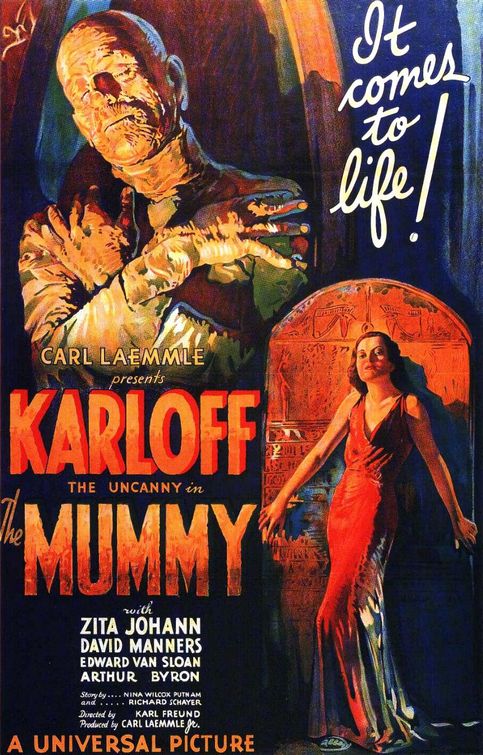
Day 354: The Mummy

The Mummy
Mummy is the word

As I child, I was really scared of mummies. At the Natural History Museum, I was terrified to go into the mummy exhibit. They may not be the first thing that comes to mind when we think of monsters and things that go bump in the night, but when you think about it, they are actually quite scary. While it's great that there are tons of movies with giant city-destroying monsters, vampires, werewolves, and extraterrestrial clowns, none of them are actually real. Mummies actually exist and can be seen up close. These are actual rotting corpses from thousands of years ago that may or may not be cursed. That's scary as hell! It's no surprise that there has been a slew of mummy-based horror movies.

The Mummy is a 1932 horror film from Universal Studios starring Boris Karloff (Frankenstein, The Mask Of Fu Manchu) as Imhotep. During an archaeological expedition in Egypt, Sir Joseph Whemple (Arthur Byron, Fog Over Frisco, The Man With Two Faces) discovers the mummy, Imhotep and the fabled Scroll of Thoth. His friend and occultist Dr. Muller (Edward Van Sloan, Dracula, Frankenstein) warns that the artifacts he has discovered are cursed and begs him to burn the scroll. During their discussion, Sir Joseph's assistant Ralph Norton (Bramwell Fletcher, Svengali, The Undying Monster) reads an ancient spell that gives life to the mummy behind him. The mummy takes the Scroll of Thoth and, upon seeing the living corpse, Norton is overcome by uncontrollable fits of hysterical laughter. Norton was committed to an asylum after the fateful night and eventually died. Ten years later, Sir Joseph's son Frank (David Manners, The Black Cat, The Death Kiss) and Professor Pearson (Leonard Mudie, Adventures Of Superman, Cleopatra) are approached by a mysterious man named Ardath Bay, an Egyptian with archaeological knowledge. He leads them the location of Imhotep's lover, Princess Ankh-es-en-amon's tomb. After digging, the treasures and mummy are donated to the Cairo Museum. It is revealed that Ardath Bay is in fact the resurrected mummy Imhotep and he intends to bring his love back to life. Bay kills Sir Joseph when he tries to stop his nefarious plans. Using his mystical powers, Bay mesmerizes Helen Grosvenor (Zita Johann) who bears a striking resemblance to Ankh-es-en-amon. Will Frank be able to stop the mummy before it's too late?

Who ordered the Mummy, extra crispy?

It's important to mention that despite being one of, if not the first mummy-based horror movies, there is no shambling mummy chasing after people. That comes in later mummy movies. We only see the actual mummy in the very beginning. Instead, we get Ardath Bay who looks like a raisin covered in mud. Boris Karloff plays the part very well and manages to make the character very creepy with his bass voice and unmoving face. I was disappointed that we didn't get the usual mummy look that I was expecting, but that can be blamed on pop culture. The rest of the cast plays their roles well enough, though David Manners isn't exactly the best leading man from Hollywood at the time. There is a decent amount of action for the time with a few scenes of violence.

The story itself is fairly decent, though it lacks the proper amount of pacing and horror seen in Dracula. The plot moves very quickly and with a run-time of about an hour and ten minutes, things feel very rushed. The scene where Norton sees the mummy alive and is overcome with laughter is quite unnerving even 80 years later. Sadly, this is really where the horror ends. The movie lacks the number of scares even during the Universal era of horror movies. What The Mummy lacks in scares, it makes up for in atmosphere. The movie has good lighting which creates long and unnatural shadows, conveying suspense and fear. The movie manages to squeeze in a little romance between Frank and Helen, but it all feels very convenient for the sake of the story. When looking at the Brendan Frasier Mummy movies, it's easy to see where some of their ideas came from.

Resurrecting your dead lover is serious business

The Mummy is a classic Universal horror movie that spawned countless remakes, re-imaginings, sequels, and adaptations. Thanks to great atmosphere and mood, the movie belongs on the Universal monster's Mt. Rushmore along with Dracula, Frankenstein, and The Wolf Man. Personally, I think the Creature From The Black Lagoon should be on there as well, but he didn't have the impact on movies like The Mummy did. The movie lacks a lot of scares and the absence of seeing a mummy with it's wrappings, shambling around after people is disappointing. Mummies should be scary, but the movie made a mistake by turning the mummy into a man. Boris Karloff is very good as Ardath Bay and the supporting cast is good enough to keep things going. The pacing of the movie is very quick which makes everything else feel rushed. While it is certainly a classic, I feel that Dracula, Frankenstein, and The Wolf Man are far better movies. Still, it's worth your time to see Boris Karloff in another fun monster movie role.

7/10

Sunday, August 12, 2012

Day 225: Black Sabbath

Black Sabbath
Sabbath, Bloody Sabbath

No, this isn't a review of a live DVD of the band Black Sabbath. Geezer Butler is not a werewolf, Tony Iommi, is not a zombie, Bill Ward is not the Blob, and Ozzy Osbourne is, well, Ozzy Osbourne. While that sounds like the best horror movie ever, today's review is actually for the movie from which the famous heavy metal band took their name. I always thought that this movie was British because the band was British, but to my surprise, it is actually from Italy. Originally titled “I tre volti della paura”, Black Sabbath is three unconnected tales of terror. It must be good if the original heavy metal band took their name from it, right?

Black Sabbath is a 1963 horror anthology directed by Mario Bava (Baron Blood, Shock). Dubbed in English from the original Italian, Black Sabbath tells three horror tales. An older Boris Karloff introduces us to each of the stories: “The Drop Of Water”, “The Telephone”, and “The Wurdalak”. In “The Drop Of Water,” Nurse Helen Chester is called to the house of a supposed medium and witch who has recently died. The old woman lays dead on her bed with her eyes wide open and a sickly grin frozen in place. As Helen prepares the body, she steals a sapphire ring off the corpse and hides it on her person. As she does, she knocks over a glass, causing water to drip on the floor. She is also harassed by a fly in the room that lands directly on the finger where the ring used to be. When she returns home, Helen is once again bothered by the fly. Strange events occur, such as flickering lights and the dripping sound of water. She begins to see the dead old woman in her house, her eyes wide and her grin still fixed to her face. What will happen to Helen? The second story, “The Telephone” tells the story of a beautiful woman named Rosy who is harassed by a phone-caller. The caller makes sexual comments and threatens Rosy, saying he will get her before the police arrive. Terrified, Rosy calls her friend Mary to come stay with her. Rosy believes the caller is Frank, her dead husband. As Rosy sleeps, Mary writes her a note begging for her to seek help. She is unaware that the caller is even closer than Rosy thought. What will happen to Rosy and who has been calling her? In the final story based on a story by Tolstoy, “The Wurdalak,” a young nobleman named Vladimir Durfe discovers a beheaded corpse with a sword stuck in it's back. He takes the sword and when he enters a village later that night, a man, Giorgio, recognizes the sword as his father's who had not been seen for five days. Vladimir stays the night with Giorgio and his family who explain their father, Gorca (Boris Karloff, Frankenstein, The Mummy) went to fight the wurdalak (vampire) Ali Beg. At the stroke of midnight, Gorca returns to the home, looking gravely pale and carrying the head of Ali Beg. His unkempt appearance, harsh disposition, and the baying of hounds convince the family that Gorca has in fact become a wurdalak. Gorca picks off the family, one by one, leaving only Vladimir and beautiful Sdenka. What will happen to them?

Ozzy looks terrible!

Black Sabbath is a prime example of how to correctly do a horror anthology. Each story manages to establish the characters and get to the point quickly. Director Mario Bava is able to craft each story well, with a good mixture of different horror styles. All three stories are both visually and psychologically appealing with plenty of fear. Boris Karloff is wonderful introducing each story adding a wry sense of humor not seen in his classic works. All three of the stories are simple, yet effective. If you read scary stories as a child, each of these should sound somewhat familiar. It's important to keep in mind that this movie came out in the early sixties and the stories were based on much older tales, so no need to scream about originality. I never like movies being dubbed as I find it distracting, but thankfully it wasn't too bad in Black Sabbath.

The Drop Of Water is colorful and atmospheric, making for a creepy feel. The woman's distorted face is unnerving and far scarier than any computerized effect. The Telephone is your typical “scary caller” horror story, made most popular by 1973's “When A Stranger Calls” with the addition of a ghost story. If the story doesn't really make sense (why would a ghost call his former wife and then try to kill her?) it's because the English version has been hacked to pieces and reworked. The original Italian version has Rosy and Mary in a lesbian affair and Frank escaping from prison. That makes much more sense than the version I watched. I suppose American/British audiences weren't ready for that type of subject matter. The Wurdalak is the longest of the stories, but probably the best. Karloff is fantastic as the vampire Gorca creating a real sense of dread in the audience. There is a good amount of fear and action in this story with some good sets and costumes. 

Paranoid

Black Sabbath is a fun movie with a set of good, basic stories. There are some good chills and a decent amount of action. There are some changes from the original version, so if you are able to, watch that one instead of the altered version. Boris Karloff is very enjoyable, showcasing his range as an actor, from clever host to terrifying monster. The directorial talent of Bava is on display as well, mixing up different styles, but still capable of delivering the horror goods. Black Sabbath is quite enjoyable and well worth your time.

8/10