Search This Blog

Showing posts with label classic. Show all posts

Sunday, December 30, 2012

Day 365: Night Of The Living Dead
Night Of The Living Dead
Good night and good luck

This is it. The end. The 365th movie review. They said it couldn't be done. I didn't even think I would make it this far, but we made it. I've seen movies about vampires, werewolves, monsters, animals, serial killers, aliens, killer clowns, ghosts, demons, Satan, and my favorite, zombies. I have seen classics, independents, movies I've always wanted to see, and movies I wish I had not. I will be taking a much needed break in the coming days, but I will be doing at least a few more posts, which will include a “Best Of” awards ceremony and Razzies for the worst. I want to personally thank each and every one of you for helping me, whether it was procuring certain movies, helping me with research, correcting some mistakes, and spreading the word. Without you, I would have stopped a long time ago. Without further ado, here is the final review for 365 Days Of Horror.

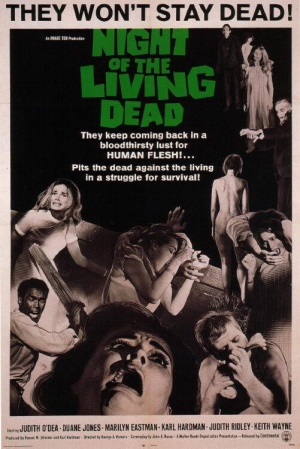
Night Of The Living Dead is a 1968 zombie movie written and directed by George Romero (Dawn Of The Dead, Creepshow). The movie stars Judith O'Dea (The Pirate, The Ocean) as Barbra and Duane Jones (Vampires, To Die For) as Ben. Barbra and her brother Johnny (Russell Streiner, The Majorettes, Night Of The Living Dead 1990) drive to rural Pennsylvania to visit their father's grave. Johnny is annoyed to be there and entertains himself by teasing Barbra. He playfully chases Barbra, pointing to another man in the cemetery and warning, “They're coming to get you, Barbra!” The man, a zombie, attacks Barbra and then struggles with Johnny who cracks his head on a gravestone. The man chases Barbra to her car and smashes the window with a rock before she is able to pull the emergency break and roll down a hill. The car crashes and Barbra flees to a nearby farmhouse where she discovers a decomposing body upstairs. When she leaves the house, she is surrounded by zombies and is saved by a man named Ben who brings her back inside. Barbra is traumatized by the events and goes into shock while Ben tries to secure the house by boarding up the doors and windows. It is revealed that a group of people have been hiding in the house's cellar the entire time. The group is made up of a young couple named Tom (Keith Wayne) and Judy (Judith Ridley) as well as Harry Cooper (Karl Hardman, Santa Claws) his wife Helen (Kyra Schon) and their daughter, Karen, who has been bitten by a zombie. The cowardly Harry tries to explain why he did not help Ben when he heard him upstairs, but Ben does not believe him. Harry insists that they are safer in the cellar, but Ben rebuffs him, claiming it is a “death trap”. While Harry and his family stay in the cellar, the rest of the group listens to the radio and television for information. The problem is widespread across the entire East Coast and the murderers, who appear to be the recently deceased, are cannibalizing their victims. While there is no definite explanation, it is believed that a space probe returning from Venus that exploded in the Earth's atmosphere may have been contaminated with radiation. A news report reveals that a rescue center has been established nearby and, with the farmhouse becoming increasingly surrounded by the undead, the group agrees to make a run for it. Ben, Tom, and Judy make a run for a truck near the house while Harry throws molotov cocktails at the zombies. Tom accidentally spills fuel on the truck, causing it to eventually explode, killing himself and Judy. Ben runs back to the house, but is unable to enter because Harry refuses to unlock the door. Ben is forced to break down the down, and after securing it, assaults Harry. Harry threatens to shot him, but Ben takes his gun and shoots Harry, who stumbles down the cellar. With the plan failing and zombies surrounding the house, how will Ben and Barbra survive?

Welcome to the gun show

Night Of The Living Dead is the movie to which all other zombie movies are compared. While there were zombie movies previous to this one, like White Zombie and King Of The Zombies, Night Of The Living Dead set the standard for the modern zombie films. George Romero crafted a horror movie that is both smart and graphic, appealing to all types of horror fans. The combination of suspense, thrills, and action makes the movie an intense and gut-wrenching experience. The movie's graphic nature was shocking at the time as we see the zombies tearing at and eating human body parts. Before NOTLD, most zombies were simply the product of voodoo and mind control. Romero created zombies that are far scarier with added aspect of cannibalism. They are violent monsters with an insatiable hunger and virtually limitless numbers. Despite being in black and white, the movie is still quite gory and bloody, especially for a movie in the 1960's. The movie cleverly leaks out bits of information about what is happening, putting the audience in the same position as the characters, causing us to relate to them. By doing this, we learn why there are zombies and how to stop them. We also learn that armed posses are combing the area, a foreshadowing of things to come.

"Oh, tombstone. You're such a great hugger."

More importantly, though, the zombies in Night Of The Living Dead are not the true monsters. As is now common among Romero and other zombie movies, social commentary is in full effect. Romero's casting of a black man in the hero role was seen as slightly controversial at the time. By doing so, the audience is forced to deal with their own personal feelings of prejudice and race. This is one of the main themes of the movie as hatred, mistrust, and deceit are all at work in the movie. Harry is a coward who is clearly out of his element, but refuses to listen to Ben, despite clearly being in control. Harry thought the best idea was to hide and hope for the best while Ben is proactive, boarding up the house and getting the radio and television to work. We all hope to be brave like Ben, but we secretly fear that at the moment of truth, we may be more like Harry. It was disappointed that Barbra was virtually useless for most of the movie and even Romero himself has stated that he was unhappy with the way she was written. The acting is good all around which helps make the movie emotional and believable. 

These flash mobs are ridiculous

Night Of The Living Dead was George Romero's feature-length directorial debut, but you would never know it. Scenes are shot with a competent confidence with a mixture of interesting angles that help convey a sense of frantic horror. The film opens up like any normal event, but quickly disintegrates into an uncontrollable horror that never ens. Less than ten minutes is all it takes for the movie to become a dire struggle for survival. Rather than having the movie take place in an easily recognizable area, Night Of The Living Dead takes place in a rural area that could be just about anywhere. Shot in central Pennsylvania, the natural open setting is all the more terrifying because it appears to be calm and comforting. The movie has a good amount of action and scares that still make modern audiences jump. The musical flourishes are great and make certain scenes far scarier than one would initially expect.

"Hey, put Cougar Town on."

Night Of The Living Dead was not the first zombie movie, but it did manage to completely change the genre. Bland mind-controlled zombies were replaced by the living dead who's only motivation is to feed on the living. The movie established new rules, like shooting zombies in the head, that are still followed to this day. The movie is shockingly violent and gory, still capable of scaring modern audiences. The story is great from the intense and frantic beginning to the brutal, depressing ending. The movie is full of important social commentary that still resonates today. The acting is great and Romero's direction is perfect. Whether you're looking for a straight-forward and scary horror film, or a smart, thoughtful movie with lots of action, Night Of The Living Dead is an all-encompassing and entertaining movie. There is a reason why the Library of Congress selected it for preservation in the National Film Registry. Unfortunately for Romero, but fortunately for you, the movie entertained the public domain because the original distributor, the Walter Reade Organization, did not put a copyright on prints of the film. The movie is now available through many different mediums, including for free on various websites. Night Of The Living Dead is an incredibly entertaining and incredibly important movie. Aspiring film makers, writers, and actors should watch the film as a blueprint for making a great movie on a limited budget. As for horror fans, it's required viewing. A movie like Night Of The Living Dead makes horror fans proud of the genre they love.

10/10

Friday, December 28, 2012

Day 363: Frankenstein

Frankenstein
In the name of Science!

There is only one monster from the golden era of horror movies that has managed to spawn countless sequels, remakes, adaptations, and spoofs while staying almost exactly the same: Frankenstein's monster. Though commonly referred to simply as “Frankenstein” the monster has changed very from it's major motion picture in 1931. When people think of Frankenstein today, they are still thinking of Boris Karloff 's stone face and neck bolts. Even the remake starring Robert De Niro in a much more realistic interpretation of how the character looks could not change the public's perception. It is a true testament to how important the 1931 movie really is. Of course, our knowledge of things get distorted over the years thanks to all the various appearances of the character. Sure we remember the big lines like “It's Alive!” but do most people know who said it? When you ask “Who was Dr. Frankenstein's assistant in the movie?” most would be incorrect in saying “Igor”. For a character so beloved in the horror world, sometimes people get the simplest facts wrong.

Frankenstein is a 1931 Universal Pictures horror movie based on the novel of the same name by Mary Shelley. The film stars Colin Clive (Bride Of Frankenstein, Jane Eyre) as Heinrich “Henry” Frankenstein and Boris Karloff (The Mummy, Bride Of Frankenstein) as The Monster, though in the beginning credits, the Monster's role is billed only with a question mark. Henry Frankenstein is a young scientist determined to reanimate dead tissue and create new life. With the help of his hunchback assistant Fritz (Dwight Frye, Dracula, The Invisible Man), Henry steals corpses in an effort to piece together a human body for his ghoulish experiments. To continue with his morbid work, Henry has become reclusive, setting up a laboratory in an abandoned watch tower far from town. Elizabeth (Mae Clarke, The Public Enemy, Waterloo Bridge) Henry's fiance, grows concerned over his increasingly strange behavior and, with the help of her friend Victor Mortiz (John Boles, Sinners In Paradise, Curly Top), reaches out to Dr. Waldman (Edward Van Sloan, Dracula, The Black Room) for help. Dr. Waldman informs Elizabeth of Henry's dark experiments and all three agree to go see him. They find Henry in the last stages of his experiment. They watch in horror and amazement as thunder and lightning start up Henry's machines and give life to the patchwork of dead body parts, giving life to a hulking monster. Unfortunately, because of a mistake by Fritz, an abnormal brain was put into the monster's body and he proves difficult to control. Though he is hideous to look at, the monster is a simple, gentle creature. He is like a newborn baby, discovering the world for the first time. Fritz takes sadistic pleasure in torturing the monster with a torch. His fear is mistaken as an attack so Henry and Dr. Waldman chains him up in the dungeon. Later, they discover Fritz strangled to death by the monster and determine that he is unfit for society. The creature eventually escapes, strangling Dr. Waldman in the process. While Henry and Elizabeth prepare for their wedding, the monster wanders through the countryside where he meets a little girl. Much to his delight, they throw flowers into a lake. When the flowers run out, he tosses the girl into the water, drowning her by accident. An enraged band of peasants pursue the monster who is headed right for Henry and Elizabeth's wedding. What will happen to this misunderstood creature and will Henry be able to save him?

"Look at that manicure! Look at that manicure!!!"

Though it doesn't have the same supernatural elements as it's counterparts Dracula, The Mummy, and The Wolfman, Frankenstein manages to be the most frightening. Though tame by today's standards, the movie truly frightened audiences in the 1930's. Multiple scenes were censored, including the one involving the monster throwing the little girl into the lake. The movie begins with a rather ingenious warning to the audience about what the shocking things they are about to see. It is a clever introduction that sets the audience up nicely. While the monster looks are unnatural, it's the basic human emotions that are both touching and unnerving. We feel for this creature, born into a world that does not understand it. Like a baby, it is innocent, with only the most basic functions of understanding and comprehending. That touching, childlike humanity makes the monster a truly sympathetic character. That sympathy is shattered when we see how strong and violent it could be. Combined with Henry's all-encompassing obsession, Frankenstein has an incredibly sad and somber tone to it despite being a horror movie. Every character suffers in some form or another, making the film a surprisingly tragic experience. The movie does have some differences from the novel, but the overall tone is very much the same. If I have any real complaint with the story is the relatively happy ending.

"Flower Power, you say?"
.
What really helps make the movie work is the great cast and solid directing. Boris Karloff's performance conveys the monster's frightening strength and incredible weakness. Though he never utters a word, Karloff is able to use simple sounds and movements that speak louder than words. His stone-solid, emotionless face also seen in The Mummy gives an unnaturalness to the monster that still unnerves audiences to this day. Colin Clive is highly enjoyable as the mad scientist Henry Frankenstein. His iconic scream of “It's Alive!” conveys his absolute madness and has been used in countless forms of media and entertainment. Universal Pictures regulars Dwight Frye and Edward Van Sloan help round out the cast with good supporting performances. Director James Whale (The Invisible Man, The Old Dark House) creates a dark and winding atmosphere, giving the film a Gothic feel. The sets are classic Universal horror and actually look better than if they were shot in a real location.

Frankenstein Meets Swamp Thing never fully materialized

We have seen Frankenstein's monster in all forms of entertainment, whether it was in the wide number of sequels, remakes, and cross-overs, or The Munsters, comic books, and Buffy The Vampire Slayer. Throughout it all, it has essentially stayed the same (Frankenberry doesn't count). The iconic monster was able to reach it's status through great acting, incredible directing, and a story that truly touches the audience. One can view Frankenstein as simply a black-and-white monster movie from the old days, but they would be missing the bigger picture. It is an existential story of man's fragile nature and society's inability to understand. It is a deep and incredibly sad story that most can relate to. The movie has a decent amount of action and some scenes deemed “too controversial” when it was first released. Thanks to the hard work and talent of all involved, Frankenstein has rightly become a classic, taking it's place on the Mt. Rushmore of Universal Monsters.

10/10

Wednesday, December 19, 2012

Day 354: The Mummy

The Mummy
Mummy is the word

As I child, I was really scared of mummies. At the Natural History Museum, I was terrified to go into the mummy exhibit. They may not be the first thing that comes to mind when we think of monsters and things that go bump in the night, but when you think about it, they are actually quite scary. While it's great that there are tons of movies with giant city-destroying monsters, vampires, werewolves, and extraterrestrial clowns, none of them are actually real. Mummies actually exist and can be seen up close. These are actual rotting corpses from thousands of years ago that may or may not be cursed. That's scary as hell! It's no surprise that there has been a slew of mummy-based horror movies.

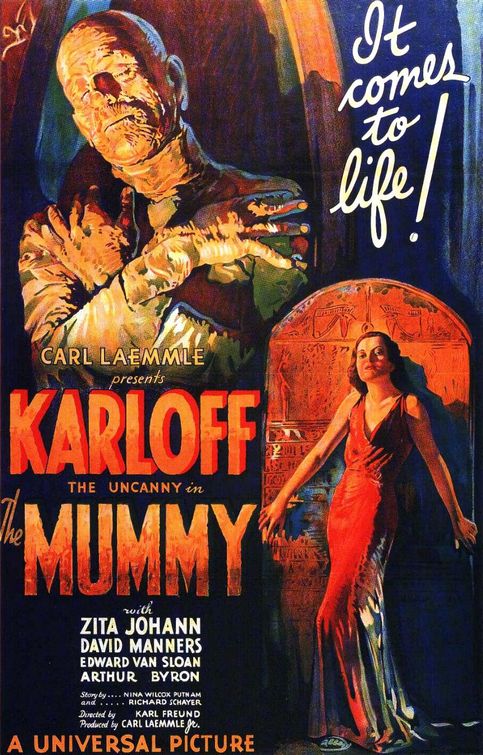
The Mummy is a 1932 horror film from Universal Studios starring Boris Karloff (Frankenstein, The Mask Of Fu Manchu) as Imhotep. During an archaeological expedition in Egypt, Sir Joseph Whemple (Arthur Byron, Fog Over Frisco, The Man With Two Faces) discovers the mummy, Imhotep and the fabled Scroll of Thoth. His friend and occultist Dr. Muller (Edward Van Sloan, Dracula, Frankenstein) warns that the artifacts he has discovered are cursed and begs him to burn the scroll. During their discussion, Sir Joseph's assistant Ralph Norton (Bramwell Fletcher, Svengali, The Undying Monster) reads an ancient spell that gives life to the mummy behind him. The mummy takes the Scroll of Thoth and, upon seeing the living corpse, Norton is overcome by uncontrollable fits of hysterical laughter. Norton was committed to an asylum after the fateful night and eventually died. Ten years later, Sir Joseph's son Frank (David Manners, The Black Cat, The Death Kiss) and Professor Pearson (Leonard Mudie, Adventures Of Superman, Cleopatra) are approached by a mysterious man named Ardath Bay, an Egyptian with archaeological knowledge. He leads them the location of Imhotep's lover, Princess Ankh-es-en-amon's tomb. After digging, the treasures and mummy are donated to the Cairo Museum. It is revealed that Ardath Bay is in fact the resurrected mummy Imhotep and he intends to bring his love back to life. Bay kills Sir Joseph when he tries to stop his nefarious plans. Using his mystical powers, Bay mesmerizes Helen Grosvenor (Zita Johann) who bears a striking resemblance to Ankh-es-en-amon. Will Frank be able to stop the mummy before it's too late?

Who ordered the Mummy, extra crispy?

It's important to mention that despite being one of, if not the first mummy-based horror movies, there is no shambling mummy chasing after people. That comes in later mummy movies. We only see the actual mummy in the very beginning. Instead, we get Ardath Bay who looks like a raisin covered in mud. Boris Karloff plays the part very well and manages to make the character very creepy with his bass voice and unmoving face. I was disappointed that we didn't get the usual mummy look that I was expecting, but that can be blamed on pop culture. The rest of the cast plays their roles well enough, though David Manners isn't exactly the best leading man from Hollywood at the time. There is a decent amount of action for the time with a few scenes of violence.

The story itself is fairly decent, though it lacks the proper amount of pacing and horror seen in Dracula. The plot moves very quickly and with a run-time of about an hour and ten minutes, things feel very rushed. The scene where Norton sees the mummy alive and is overcome with laughter is quite unnerving even 80 years later. Sadly, this is really where the horror ends. The movie lacks the number of scares even during the Universal era of horror movies. What The Mummy lacks in scares, it makes up for in atmosphere. The movie has good lighting which creates long and unnatural shadows, conveying suspense and fear. The movie manages to squeeze in a little romance between Frank and Helen, but it all feels very convenient for the sake of the story. When looking at the Brendan Frasier Mummy movies, it's easy to see where some of their ideas came from.

Resurrecting your dead lover is serious business

The Mummy is a classic Universal horror movie that spawned countless remakes, re-imaginings, sequels, and adaptations. Thanks to great atmosphere and mood, the movie belongs on the Universal monster's Mt. Rushmore along with Dracula, Frankenstein, and The Wolf Man. Personally, I think the Creature From The Black Lagoon should be on there as well, but he didn't have the impact on movies like The Mummy did. The movie lacks a lot of scares and the absence of seeing a mummy with it's wrappings, shambling around after people is disappointing. Mummies should be scary, but the movie made a mistake by turning the mummy into a man. Boris Karloff is very good as Ardath Bay and the supporting cast is good enough to keep things going. The pacing of the movie is very quick which makes everything else feel rushed. While it is certainly a classic, I feel that Dracula, Frankenstein, and The Wolf Man are far better movies. Still, it's worth your time to see Boris Karloff in another fun monster movie role.

7/10

Wednesday, December 12, 2012

Day 347: Jaws

Jaws
Jaws, you seriously have to go to the dentist

Movies, like words, have power. Some may scoff at the idea that watching a movie or even reading a book could affect one person, let alone large groups of people, but it's true. The novel Coma, a story about hospitals selling organs was later adapted into a film and caused organ donations to drop 60%. Even the original broadcast of War Of The Worlds caused massive panic. Even though these are just forms of entertainment, they still to this day manage to cause fear and hysteria. While that says a lot about the gullibility and paranoia of humans, it also says a lot of the movies and books themselves. No horror movie still has quite the affect on people like Jaws.

Jaws is a 1975 horror thriller, based off the novel by Peter Benchley, directed by Stephen Spielberg (E.T., Saving Private Ryan). The movie stars Roy Schneider (The French Connection, 2010) as Chief Martin Brody and Richard Dreyfuss (Close Encounters Of The Third Kind, Mr. Holland's Opus) as Matt Hooper. Days before the Fourth of July weekend begins on Amity Island, a young woman named Chrissie is mauled by a shark. Chief Brody wants to shut down the entire beach to ensure that no one else is attacked, but Mayor Larry Vaughn (Murray Hamilton, The Graduate, The Hustler) pressures Brody to reconsider. He claims that the entire town will suffer if the beaches are closed, taking away precious tourist dollars. Vaughn tries to pass off Chrissie's death as possibly a boating accident. When a young boy is killed by the shark, a bounty is placed, sparking a small frenzy by amateur fishermen. Quint (Robert Shaw, The Sting, From Russia With Love), a salty veteran fisherman, offers to capture the shark for $10,000, but no one takes him up on it. Marine biologist Matt Hooper comes to Amity and inspects Chrissie's body, declaring it most definitely the work of a shark. The amateur fishermen capture a large tiger shark relieving the town, but not Hooper. That night, Hooper and Brody cut open the shark and find no human remains inside. After inspecting a boat that had been attacked, Hooper discovers a tooth belonging to a great white shark. On the Fourth Of July, the shark attacks again, killing a man and sparking a panic. Brody convinces Vaughn to hire Quint as both he and Hooper join him on the mission. While Brody throws chum out into the ocean, the beast surfaces, showing just how large it truly is. Quint estimates it at twenty-five feet in length and over 6,000. How will these three men defeat this behemoth killing machine?

A pack of smokes a day might work

It's not often that a movie, especially a horror movie, has cultural and environmental repercussions, but when it does, you know you've made something larger than anyone could have predicted. Real life attendance at beaches were down following the movie's release and the number of sharks killed reached the thousands. Shark attacks do occur in real life, but not to the degree they do in Jaws. Peter Benchley actually regretted writing his novel because of all the deaths. That doesn't stop people from fearing that a shark will get them every time they go into the ocean. Heck, as a little kid, I was afraid there were sharks in a pool. A pool! How does this happen? It happens because the movie is so incredibly convincing. The movie's tension and suspense are what make the fear so believable. The attacks happen in broad daylight and are undiscerning. Men, women, and children are all victims and to make things worse, they are all completely helpless. The shark stays hidden for most of the film, allowing the audience to cast their own fears upon this deep-sea killer. While this was partially due to malfunctions with the mechanical shark, it worked to the movie's favor. When we finally see the shark, it is more terrifying than the audience could possibly imagine. It is incredibly large and impossibly vicious. Coupled with the movie's large amount of violence and massive amounts of blood, the shark is the epitome of horror.

The story of Jaws was inspired by actual shark attacks in New Jersey in 1916. They weren't exactly at the level of the attacks in Jaws, but it did spark the same amount of frenzy. All of this does raise the question, “Is any of this possible?” Well, I am no shark expert, but lucky for us, I happen to know one. Chuck Bangley is a PhD student specializing in sharks and marine biology and was kind enough to give lend his expertise to 365 Days Of Horror: “White sharks are physically capable of most of Jaws' feats of strength, at least in the first movie. Any given Shark Week special will show that great whites are capable of leaping out of the water, and they are capable of ramming through a shark cage (though they'd likely hurt themselves in the process). Real great whites are not nearly as motivated to destroy boats and eat humans as the shark in Jaws, though there are documented cases of sharks accidentally landing on boats and doing some damage. White sharks do occur in the New England waters where Jaws takes place, and the population has been steadily increasing as seal numbers increase on Cape Cod. Large predatory sharks are usually highly migratory, so it's unlikely that Brodie, Quint, and Hooper would succeed in hunting down the right one. Modern satellite tagging has proven that large, potentially dangerous sharks like great whites and tiger sharks cover huge ranges, and any shark responsible for an attack on a human would likely be miles away before any response could happen. This is why shark culls following attacks aren't effective.” Thanks, Chuck! Be sure to follow Chuck on Twitter at @SpinyDag and read his shark-related adventures at http://yalikedags.southernfriedscience.com/

FurryCon 2012

Jaws was the original summer blockbuster with it's combination of action, thrills, and suspense. Spielberg uses his careful eye to capture all the actual while spending enough time to build up atmosphere and tension. The movie's iconic music is simple, yet powerful. To this day, the “Dunnn dun. Dunnn dun.” theme only means that something big and bad is coming. Both Roy Schneider and Richard Dreyfuss play their roles very well, each bringing something different to their roles, creating unique, but relatable characters. Robert Shaw is great as the old-timer Quint, giving the movie a harsher, realistic edge. While some may say that the movie fits into the action genre, it is most certainly horror. There are real scares and plenty of atmosphere. Jaws is a classic for a reason as it is good from top to bottom. It's well-known and well-loved and deserves all the accolades it gets.

10/10

Friday, November 30, 2012

Day 335: A Nightmare On Elm Street

A Nightmare On Elm Street
I hope that's just sweat in the bed

When I was young, I was scared of Freddy Kruger. I mean, he's get the messed-up face, the glove with blades on the fingers, and a horrific cackle. What kid wouldn't be afraid of that? The Freddy Kruger character was revolutionary for horror films. Up until he came out, most slasher villains were unstoppable hulking monsters, hacking and slashing their way through a group of unsuspecting teens. Freddy is different, though, frequently speaking and even toying with his victims. He also went after people with a purpose rather than a random group of people. But what separated Freddy the most was how he killed you; in your dreams. I have previously reviewed the remake to A Nightmare On Elm Street, but I thought I should give the original it's due.

And give Johnny Depp's hair it's due too

A Nightmare On Elm Street is a 1984 slasher film written and directed by Wes Craven (Scream, Last House On The Left). The movie stars Robert Englund (Urban Legend, Wishmaster) as serial killer Freddy Krueger and Heather Langenkamp (Growing Pains, Just The Ten Of Us) as Nancy Thompson. Both Nancy and her friend Tina Gray (Amanda Wyss, Fast Times At Ridgemont High, Silverado) have intense nightmares about a man with razor-sharp knives on his hand chasing them. Tina even wakes up with slashes through her nightgown, but her mother blows it off as her having long fingernails. The next night, the girls go over to Nancy's boyfriend Glen's (Johnny Depp, Pirates Of The Caribbean, Edward Scissorhands) house. Tina's boyfriend Rod also shows up and they sleep together while Nancy and Glen sleep in separate rooms. Tina has another nightmare where she is once again stalked by the hideous figure. In her dream, he finally catches her while in reality, her body begins to levitate around the room and slam into the walls. She calls out the name “Freddy Krueger” before dying. Rod is the only person in the room when Tina is called, and is taken to jail for her murder. While at school, Nancy has another nightmare about the man who taunts her as he stalks. That night she asks Glen to stay awake while she sleeps just in case she looks like she's in trouble. Through her dream, Nancy sees the man go into Rod's jail cell and kill him, making it look like a suicide. Glenn falls asleep and Nancy is almost killed. Terrified of her dreams, Nancy goes to a sleep clinic to be evaluated. She has another dream of the man and is actually able to pull the fedora he wears out of her dream and into reality. Nancy's mother reveals that Freddy Krueger was a child murderer who escaped imprisonment due to a technicality. The enraged parents took the law into their own hands and killed Krueger by fire. Somehow, Krueger has risen from beyond the grave and is now killing the children of the town through their dreams. How will Nancy be able to stop something that isn't even real?

It's the Silly Puddy Killer!

A Nightmare On Elm Street is a special horror movie because it took a popular genre of horror and injected it with new life. It is something completely different from what had been done prior while still being true to the basic tenants of slashers. Like other slashers, the victims are helpless teens and two are killed after having sex. Typical slasher movie with an atypical twist. Rather than just having a faceless, speechless monster as the villain, A Nightmare On Elm Street employs Freddy Krueger. Krueger loves to speak, taunting his victims and playing with their minds. We also see his face for extended periods, something not too common in slashers, even if it is disfigured. Ultimately, the roll works because Robert Englund is just that good. He captures the sinister evil of the character while still showing a deranged flair for his “work”. Other slasher icons like Jason and Michael Myers kill because that is what they do. There is no real purpose, people just happen to get in their way. Freddy kills with a purpose, making the kids pay for the sins of their fathers, so to speak.

Paging Dr. Freud

The movie manages to blur the line between reality and dreams which make the shocks more shocking and the scares scarier. Craven does a good job of never allowing the audience to know just what is real and what is dream. The various kills in the movie are incredibly entertaining in their creativity and variation. With the large amount of violence comes an even larger amount of blood. One scene can accurately be described as a “blood geiser”. Craven captures both the violence and the horror very well, never shying away from either. Krueger is still scary before he became watered down in subsequent sequels, cracking wise and spouting bad puns. Heather Langenkamp is very good as a believable heroine. It's also fun to see a young Johnny Depp before he became life partners with Tim Burton.

"Gimme five!"

A Nightmare On Elm Street is highly imaginative and creative when slasher movies were just about out of gas. It's a smart horror film that doesn't require the audience do dumb themselves down in order to enjoy. There is a good amount of fear and suspense throughout the movie thanks to Craven's solid writing, good pacing, and competent direction. Robert Englund is fantastic as Freddy Krueger giving the character a sadistic glee to his murderous intent. There is a wide variety and creativity in the kills doled out by Krueger, keeping the movie from lapsing into a generic slasher. A Nightmare On Elm Street is well-made and incredibly fun. It's no wonder it's considered a classic.

9.5/10

Tuesday, November 20, 2012

Day 325: White Zombie

White Zombie
Thunder Kiss '65

Zombies are totally in right now. Thanks to The Walking Dead, a rash of zombie movies, and a few real-life face-eating incidences, zombies are the hip thing. There used to be a time when you actually had to explain to people what a zombie was. Now, even little old ladies know to shoot them in the head. I'm not saying it's a bad thing, it's just hard having your special thing become pop-culture. Thankfully, there are plenty of other zombie-related things out there for the super horror fans to enjoy. As one of those zombie nerds, I've seen a lot of them. Many of the newer ones are just plain terrible, so I'm forced to go back in the past to find a gem. Might as well go all the way back to the first feature-length zombie movie, right?

White Zombie is a 1932 zombie movie starring Bela Lugosi (Dracula, Son Of Frankenstein) as Murder Legendre. In the country of Haiti, Madeline Short (Madge Bellamy, The Iron Horse, Under Your Spell) reunites with her fiance, Neil Parker (John Harron, The Invisible Menace, Street Girl). Set to be married that night, the two travel by coach through the Haitian forest, when the happen upon a burial in the middle of the road. Their native driver informs them that it prevents grave robbers from doing their unholy business. As they travel, they come across Murder Legendre, a local sugar cane baron and voodoo master who supposedly controls zombies. The driver sees these zombies and quickly pushes onward, leaving Legendre holding Madeline's scarf. They arrive at the home of plantation owner Charles Beaumont (Robert Frazer, The Three Musketeers, Law Men) who secretly loves Madeline. Desperate to win Madeline, Beaumont asks Legendre for help. Legendre gives him a potion that will give Madeline the appearance of death, only to rise like a zombie at a later time. The potion works and Madeline is soon buried. A depressed Neil later discovers that Madeline's body is missing from her tomb and enlists the help of Dr. Bruner (Joseph Cawthorn, The Taming Of The Shrew, Lazy River) to find out what has happened. Beaumont comes to regret his decision as a zombified Madeline shows no emotion and is a shell of her former self. He begs Legendre to change her back, but is drugged himself. Will Neil stop Legendre from zombifying the entire island and save Madeline before it is too late?

Staring contest! 123go!

White Zombie is widely considered to be the first feature-length zombie film. The story plays out as one might expect, though that is probably due to later films following the movie's lead. There is a good amount of suspense in the film and some tame action. I generally wanted to know what was going to happen to Madeline and Legendre. Legendre is a classic old-timey villain, complete with evil-looking eyebrows. His intentions were a little too vague for my liking and could have used some more attention and detail. The zombies are the traditional drugged and mind-controlled people of voodoo legend. You can't really expect to have corpses rising from the grave and eating people in the 1930s. The zombies themselves tend to look a bit silly, with some extra hair glues to their face. The movie had a fairly small budget and reused many sets from Universal's other horror movies of the time. While the small budget didn't completely hurt the movie, I think a little more money could have gone a long way.

It should be no surprise that Bela Lugosi is the best thing about White Zombie. He often channels his inner-Dracula, using his piercing glare to control his zombies. It was neat to see how the movie focused on his eyes and his hands so much. Never has a movie shows closeups of hands and been so full of tension. Madge Bellamy pulls off her zombified state very well, having a completely blank stare for entire scenes. Her large eyes and doll-like features certainly helped give her a stone cold appearance as a zombie. Both John Harron and Robert Frazer are way over-the-top in the portrayal of their characters. Certain scenes become almost comedic thanks to their overacting.

"Gasp! They're real and they're spectacular!"

Though very tame by today's standards, White Zombie is still an enjoyable horror movie. It's influence was seen in later zombie movies such as "I Walked With A Zombie" and "King Of The Zombies". The story is incredibly simplistic, but good nonetheless. There are some eery moments and a small fright here and there. Bela Lugosi is very enjoyable to watch, especially when he goes into his mind-control stare. Without him, the entire movie would have been a horror footnote at best. The zombies don't look that great, but they serve their purpose well enough. While it is not in the same league as other Universal horror movies like Dracula, The Wolfman, and Frankenstein, White Zombie is still a horror classic and can be enjoyed by many different age groups.

7.5/10

Tuesday, November 13, 2012

Day 318: Dracula

Dracula
Don't call him "Drac"

Dracula. The Mummy. Frankenstein. The Wolfman. Call them “classic monsters” or “cinema monsters” or the “Universal Four”. These four are the ones you think of when you hear the words “monster movie”. Their main stories come from literature, but the basic premise from each come tales passed down from generation to generation. Each theme, whether it's man battling the beast within or man versus the unknown, has played out for centuries. It's this ability to reach out across generations that has allowed these characters to be reused and remade over and over again across literature, entertainment and pop culture. The most popular of these Universal monsters is Dracula. Need proof? Next Halloween, count how many vampires you see with black capes and fangs. Kids aren't going around like sparkly vampires with emotional problems. At least, let's hope not.

Dracula is a 1931 vampire horror film starring Bela Lugosi as Count Dracula (Son Of Frankenstein, Bride Of The Monster). The film is based on the play Dracula by Hamilton Dean and John L. Balderstonr, which was based on Bram Stoker's novel Dracula. Renfield (Dwight Frye, Frankenstein, The Invisible Man) travels to Transylvania to meet with Count Dracula to settle a business deal. He is dropped off at a small village and informs some people that he is going to Dracula's castle. He is warned that vampires inhabit that castle, but insists on having a carriage take him. An innkeeper's wife gives Renfield a crucifix for protection. The carriage ride is particularly rough and when Renfield sticks his head out the window to ask the driver to slow down, he is shocked to find the driver has disappeared and a bat is now leading the horses. Once inside the castle, Renfield is greeted by the eccentric Count Dracula. Through Renfield, Dracula has purchased Carfax Abbey in London and is planning to go there the next day. Dracula turns Renfield into his slave who protects his coffin as they travel by ship to London. When the ship arrives, a raving mad Renfield is found to be the only living person on board. He is committed to Dr. Seward's (Herbert Bunston, Cardinal Richelieu, The Enchanted Cottage) sanitarium. At the same time, Dracula meets Dr. Seward at the theater, along with his daughter Mina (Helen Chandler), her fiance John Harker (David Manners), and family friend Lucy Weston (Frances Dade). Dracula charms them and later that night, drinks Lucy's blood, eventually killing her. Professor Van Helsing (Edward Van Sloan, A Shot In The Dark, The Mummy) is brought in to treat Renfield, and after studying his blood, begins to suspect a vampire is in their midst. Dracula then bites Mina with plans to turn her into a vampire. Will Professor Van Helsing and John be able to stop him before it is too late?

Can you smmmeeeeellllllll what Dracula is cooking?

This movie is over 80 years old. Let that sink in for a moment. Some movies barely hold up 5 years after they've been released. Dracula is completely timeless, still capable of striking fear into the audience while maintaining an exciting story. Though the run time is shorter than modern movies (a little over 70 minutes), the story has a steady layout. The film has a great atmosphere thanks in part to keeping the aesthetics from the play it was based on. Simple tricks like lighting and fog add to the overall creepiness of the story. One interesting thing that I noticed was that there wasn't a lot of music throughout the film. Maybe I'm just so used to movies blaring strings and telling the audience when to be scared, but it was refreshing to see a movie that didn't assault my ears. Instead, we are free to focus on the fluid dialogue and, even better, Bela Lugosi's performance.

There are few actor's who so perfectly define a role than anyone playing the character after them will never come close to their greatness. Bela Lugosi is Dracula. His unblinking, steely glare and hand motions truly give the character a supernatural feel. He is both charming and dangerous throughout the film, making it difficult to root against him. The supporting roles are played well, adding credence to the story. While there were a few scary movies prior to this, Dracula was one of the first to completely embrace the supernatural themes. There was no wink-and-nod at the end saying it was just a work of fiction. Nowadays, the special effects may seem quaint with the giant rubber bat on a string, but I wouldn't have it any other way.

I love his invisible puppet trick

Dracula is the quintessential classic horror movie. It takes a classic character from literature and brings it to the big screen with the effort and respect it deserves. Bela Lugosi is fantastic as Dracula, creating a timeless character that is enjoyable to watch while still being scary. The story has a fast pace but hits all the important parts of the story. For the time, it has good excitement and even a bit of action. Dracula can be enjoyed by both young and old, though I would suggest waiting to show this one to the very young. You're better off with Hotel Transylvania or a box of Count Chocula. Dracula is still thoroughly enjoyable despite being over 80 years old and well worth your time.

10/10

Saturday, November 10, 2012

Day 315: The Amityville Horror

The Amityville Horror
Home is where the horror is

The haunted house, as a means of delivering horror, goes far beyond film. Stories have been passed down through the generations, speaking of evil spirits and unholy things that dwell within our own homes. We've all been alone in a house and felt a creeping uneasiness. We know full well that no one else is home, but are sure that there is something “else” with us. Creaking floors, settling foundations, doors that never stay closed; while these may have simple explanations, the mind runs wild with fear and anticipation. It's this real-life fear that allows the haunted house story to still strike fear into the hearts of an eager audience.

The Amityville Horror is a 1979 horror film based on the the book of the same name written by Jay Anson. The story is said to be based on real-life paranormal events witnessed by the Lutz family. The movie stars James Brolin (The Car, The Cape Town Affair) as George Lutz and Margot Kidder (Superman, Black Christmas) as his wife Kathy. An unknown assailant murders an entire family without a motive in a house in Amityville, New York. Years later, George and Kathy Lutz purchase the house and move in with Kathy's three children. While George is not religious, Kathy asks Father Delaney (Rod Steiger, On The Waterfront, Oklahoma!) to bless their new house. He experiences trouble while trying to do his blessings, including trouble breathing, a door inexplicably shutting and being surrounded by flies, despite being out of season. He hears a disembodied voice yell “Get out!” and overcome with sickness, Father Delaney flees. As the days go by, George starts to change, becoming more sullen and aggressive. He ignores his work and the family finances, causing Kathy to become afraid. Her daughter Amy also begins to act strangely, saying she has a new invisible friend named Jody. When Kathy's sister, a nun, comes to visit, she immediately becomes sick in the house and leaves. When one of Kathy's boys has a window randomly shut on his hand, it becomes apparent that a malevolent force is present in the house. Father Delaney tries to use faith and prayer to rid the house of evil, but it follows him even to the church, eventually taking his eyesight. Research reveals that the house was built on a tribal burial ground and was once home to a devil worshiper. Will George be able to free himself from the grip of the house before it's too late?

"Oh, Choppy. You're the only one who gets me."

This was the first time I had watched The Amityville Horror and thanks to pop-culture references and spoofs, I had high expectations. The house in which the story is based on was actually for sale not too long ago, so that probably increased my desire to see the film. Sadly, I cam away very disappointed. When it was first released, the movie performed very well at the box office, earning more than $80 million. Perhaps my expectations were too high or maybe I've just seen too many horror movies, but I felt that the movie came off as middling and tedious. The story itself is interesting on the surface and the general mystery of what is going on with the house kept me interested. The payoff is rather weak, made all the more worse with an extra-long run time. The movie does go the religious route similar to The Exorcist, but it feels like they didn't know where to go with it. All the focus on Father Delaney could have been cut from the movie without any damage to the story itself. The is some excitement and action in the movie, but the blood and gore is pretty tame, even by 1970's standards.

It's not all terrible, though. There are some very good, recognizable scenes in the movie, such as George climbing the stairs with an axe, the walls bleeding, and Father Delaney being surrounded by flies. The music is also very good, receiving an Academy Award nomination for composer Lalo Schifirin. James Brolin is good in his role that requires a wide range of emotion. He is able to pull off both a loving husband and a deranged maniac convincingly. Margot Kidder is alright, but overacts in certain scenes. The same could be said for some supporting roles as well. The direction is good thanks to some creative angles and letting scenes run their course. The editing was a little bit off, at least to me, as certain scenes felt like they came out of nowhere. 

The flies love Father Shitface

I expected a lot out of The Amityville Horror, but it didn't meet my expectations. The film is slow most of the time, but there are a few good scares and jolts. The music is good and there are some fun, iconic scenes. The movie is a little too long and the acting could have been better. The mystery is enough to keep the movie going, but the ending was not very satisfying. By today's standards, the movie lacks the necessary violence and blood to be truly thrilling. It's fun to know that there is an actual house where the movie was based on, even though the movie was actually filmed in Toms River, New Jersey. While The Amityville Horror isn't great by any means, it still has it's moments and is a good starter movie for people who do not like horror.

5.5/10

Wednesday, October 31, 2012

Day 305: Halloween

Halloween
Who wants pumpkin pie?

C'mon, like I was going to review any other movie on Halloween. Sex In The City did cross my mind, but even I can't handle that type of unspeakable horror. While not the first in the slasher genre (Both Black Christmas and The Texas Chainsaw Massacre predate it), Halloween propelled the idea to the next level, spawning countless knock-offs, remakes, and sequels. It also helped make John Carpenter a household name in the world of horror. While Halloween was not intended to be a franchise based on Michael Myers, the character proved to be so popular that when the third Halloween had nothing to do with the killer, audiences reacted negatively. Rather than randomly picking a movie out of the franchise and possibly suffering through the one with Busta Rhymes, I figured it's best to start at the beginning.

Halloween is a 1978 slasher horror film written and directed by John Carpenter (They Live, The Thing). The movie stars Jamie Lee Curtis (Trading Places, True Lies) as teenager Laurie Strode and Donald Pleasance (Escape From New York, Prince Of Darkness) as Dr. Sam Loomis. On October 31, 1963 in Haddonfield, Illinois, a young boy named Michael Myers brutally murders his sister with a butcher knife. Michael is sent to Smith's Grove Sanitarium where he is placed under the care of Dr. Loomis. For almost fifteen years, Michael remains in an almost catatonic state, showing no emotion and never speaking. The night before Halloween, Michael escapes the sanitarium and Dr. Loomis desperately tries to track him down, believing he will head back to his childhood home. The next day, high school student Laurie Strode continuously has the feeling that she is being watched and followed. She is unaware that Michael Myers is the one stalking her. That night, Laurie babysits a young boy named Tommy Doyle (Brian Andrews, Halloween II, The Great Santini) while her friend Annie (Nancy Kyes, Assault On Precinct 13, The Fog) babysits a young girl named Lindsay Wallace. Tommy is constantly afraid that the boogeyman is going to get him, but Laurie reassures him that there is no boogeyman. Dr. Loomis combs the streets with the local sheriff, searching in vein for Michael, who is going around the neighborhood killing people. Annie goes to see a boy and drops Lindsay off with Laurie, but is soon murdered by Michael. Will Dr. Loomis be able to stop Michael in time before he gets to Laurie and the kids?

It's like ten thousand spoons when all you need is a JESUS, LOOK AT THAT KNIFE!

This is the movie that started it all for slashers and it did so on the strength of it's story, not with a big budget or fancy effects. Made for around $325,000, Halloween manages to be scary and thrilling without the use of gimmicks. Carpenter weaves a story that is entirely realistic which helps give the movie a scary credibility. Setting the events in the suburbs and in people's homes brings the fear straight to the audience. The atmosphere is dark without drifting off into fantasy. The music is probably one of the most lasting parts of the movie. Everyone knows the classic theme music, but it's the simple 2-note piano throughout the film the truly creates tension. We know something is going to happen, just not what or when or where. The movie has a good amount of action with some fun and unique kills. There is a decent amount of blood, but nothing compared to today's movies. There are some truly great scenes like when Laurie continuously finds bodies in the house and when she fights Michael at the end.

The character of Michael Myers is the manifestation of all our fears. He is unstoppable in his singular goal of murder. There is no reasoning with him, no pleading for your life. He does not speak and his featureless mask (a modified Captain Kirk mask) allows the audience to project whatever they want onto the killer. Carpenter does a great job of drawing the audience in at the beginning and then paying off when it comes to the action. Jamie Lee Curtis is very good in her role and comes off as a believable heroine at the end. The movie does run into a little bit of trouble with the “annoying kid” factor, but so much is going on that it's easy to ignore. Donald Pleasance is great as Dr. Loomis, exuding an air of urgency while still remaining level-headed. It's his steely resolve that makes his mission seem all the more important. If he was frantic and terrified, it would have made the movie cartoonish and silly. Thanks to Carpenter's writing, the characters are all believable and enjoyable to root for.

Paper beats rock, gun beats giant butcher knife

While it wasn't the first slasher, Halloween may be one of the most important horror movies. It is proof that you don't need a big budget to make a lot of money and have an impact on future generations. The story is highly enjoyable and treats the audience as equals. Donald Pleasance and Jamie Lee Curtis are both very good in their roles and help make the movie more complete. The action is solid and the kills are fun to watch. The movie has the right kind of atmosphere, thanks largely to the great, simple music. While a little tame compared to today's standards, Halloween still has a lot of frights and a genuine feeling of horror. Once you're done trick or treating and partying, turn off the lights, curl up on the couch and watch the horror classic.

10/10

Tuesday, October 30, 2012

Day 304: Creature From The Black Lagoon

Creature From The Black Lagoon
Apparently, the lagoon gives you soft, pouty lips

Dracula. The Wolfman, Frankenstein's monster (Frankenstein is the name of the doctor, people). The Mummy. These classic movie monsters receive lots of love and attention and rightfully so. They've had countless remakes and adaptations, appeared in video games, comic books, and products. To this day, people still get dressed up as these monsters for Halloween. There is one classic monster that always seems to be left out: The Creature from the Black Lagoon. What is it about the creature that doesn't put it on the same level as the others? Is it because the creature doesn't really come from a well-known novel? Is it a lack of sequels and remakes? Is it because it doesn't actually have a name? It's certainly not because the movie is bad.

Creature From The Black Lagoon is a 1954 monster movie starring Richard Carlson (It Came From Outer Space, The Magnetic Monster) as Dr. David Reed and Julie Adams (The Rifleman, Maverick) as his girlfriend, Kay Lawrence. While on an expedition in the Amazon, Dr. Carl Maia (Antonio Moreno, The Searchers, The Spanish Dancer) discovers the skeletal remains of an arm that appears to have a webbed hand. Maia is able to convince his friend Dr. David Reed, an icthyologist, to aid him in the excavation of the skeleton. They are joined by David's girlfriend Kay and Dr. Mark Williams, who funds the expedition. The take the steamer Rita down the Amazon to the camp site, where they find Maia's team brutally murdered by some sort of animal. Unknown to the group, the killer was actually an amphibious humanoid, the same species as the skeleton that Dr. Maia discovered. The group travels into the nearby black lagoon in hopes of finding more of the skeletal remains. The creature, or Gill-man, watches the expedition as the search the lagoon and becomes infatuated with Kay. It eventually kills two of the crew members on the ship. They poison the water and are able to capture the creature for a short time, but it escapes. Will they be able to capture this creature before it takes Kay?

"Has anyone seen my chapstick? I'm feeling chappy."


In classic monster movie fashion, Creature From The Black Lagoon has an equal mixture of mystery, action, romance, and traditional scares. While the movie may be almost 60 years old, it still manages to be quite entertaining. The action starts out almost immediately despite not showing the creature right away. We only see it's amphibious webbed hand, but it's enough to whet the audience's appetite and send imagination's soaring. Gill-man is essentially a man in a rubber suit (technically two different men, one for land shots and one for swimming), it looks far better than other monsters from the same era. Strong detail is given to the suit with authentic looking skin and fins. The face does have some motion to it and actually appears to be breathing when out of water. Many of the underwater scenes look very good, thanks to being shot in a studio rather than an actually body of water.

Originally filmed in 3D, the movie doesn't have the usual hallmarks you see in modern 3D films. There are no blatant scenes where someone is specifically pointing something at the screen for 3D purposes. The horror of the film is helped along thanks to the music in the film, which consisted mostly of blaring trumpets. It serves it's purpose, but tends to be a little grating by the end. Director Jack Arnold has a good eye for capturing both the action and terror in the movie. The acting is good, especially considering the creature is just a guy in a suit. Julie Adams doesn't play the straight damsel in distress role, giving the character more depth. There are just enough characters involved to kill off a few without diluting the story. The movie has a good amount of action, but since it's from the 1950's, of course there is no blood. C'mon, there are kids watching!

"Attica! Attica! Attica!"

Creature From The Black Lagoon is a fun monster movie from an era where a man in a rubber suit was still terrifying. The story movies quickly and has a good amount of action for the time period. The underwater scenes look great and the makeup used for the monster is spot-on. The combination of good acting and directing helps elevate the movie to a better level than other contemporary monster movies. The movie doesn't have the built-in story that other classic monster movies do, but it still manages to be entertaining. Why Gill-man doesn't get as much attention as it deserves, it's still a classic monster from a classic movie. Maybe you should dress up like Gill-man for Halloween tomorrow.

8/10

Saturday, October 6, 2012

Day 280: When A Stranger Calls

When A Stranger Calls
Please don't call me, maybe

Certain movies are forever defined by one great scene. Even if you've never seen certain movies, specific scenes are easily recognizable. Whether it's clip shows or spoofs or references, you know exactly what movie it comes from. Some good examples are when Sissy Spacek is covered in blood at the prom in Carrie, the eye-torture scene in A Clockwork Orange, and Jack Nicholson chopping down the door in The Shining. Of course, these movies have a lot more going for them than just their iconic scenes. How would another movie fair when the iconic scene in the movie is the most exciting part?

When A Stranger Calls is a 1979 psychological horror movie starring Charles Durning (O, Brother Where Art Thou?, To Be Or Not To Be) as Officer John Clifford. Jill Johnson (Carol Kane, Seinfeld, Annie Hall) is babysitting two young children for Dr. and Mrs. Mandrakis when she starts to receive disturbing phone calls from an anonymous man. The voice repeatedly asks her if she has checked on the children. Frightened, she calls the police who offer to trace the phone calls in hopes of finding the culprit. It is revealed that the calls are coming from inside the house and Jill flees. The caller, a mentally disturbed British man named Curt Duncan (Tony Beckley, Doctor Who, The Italian Job), brutally murdered the two children with his bare hands and is placed in an asylum. Seven years later, Duncan escapes the asylum and Dr. Mandrakis hires John Clifford, the former police officer who investigated the case, to find and kill Duncan. Duncan is a vagrant in the city and is constantly pursuing a woman named Tracy (Colleen Dewhurst, Who's Afraid Of Virginia Wolf?, Caligula) who constantly rebuffs his advances. Clifford becomes increasingly aggressive and obsessed with finding Duncan before he kills again. He manages to find Duncan and a chase ensues, but Duncan escapes. Duncan eventually sees a newspaper with a now-adult Jill Johnson's picture in it. Will Clifford be able to stop him before he returns to murder Jill?

Yes kids, that's what a phone used to look like

The first twenty minutes of When A Stranger Calls may be the most suspenseful opening of any horror movie. The scene is has reached an iconic status, landing the movie on many Top scary movie lists. The scene is laid out perfectly with the proper amount of timing and pacing. Carol Kane does a great job as the audience is essentially living through her, sharing her fear and terror. It's is quite impressive considering that Kane is essentially acting by herself with just voices on a telephone working with her. The music is fantastic in the scene, creating an eerie atmosphere and swelling at just the right moments. It's just such a shame that a majority of the movie is nothing like those first twenty minutes.

Most of the movie follows John Clifford, who was on the scene the night of the murders. I'm a little confused as to why he took the case so personally. I mean, I understand the horrible trauma of the murders, but it's not like Clifford had been chasing Duncan before or after the incident. He just kind of waltzed into the crime scene with a bunch of other police officers. All the suspense and fear in the first 20 minutes completely disappear as the movie focuses on Duncan and Tracy for some reason. Why bother focusing on Tracy at all? The movie would have been better served following Jill as she was the one who actually endured the horror of that fateful night. It's a huge missed opportunity that could have led to more scenes of suspense and horror. Why not show how she has managed to make a life, but is still traumatized? We eventually get to that in the last twenty minutes, but what is the point when most of the movie essentially forgot about her? This shift in the story slows to a crawl, making for a boring watch. The acting is fine, though I question the choice of Tony Beckley as the killer from a physical standpoint. His voice is great, but he is a rather slight man and it's hard to believe he could brutally eviscerate people, albeit children, with his bare hands. 

 Cake or pie? Why not both?

When A Stranger Calls is a boring police story book-ended by two great scenes of horror and suspense. The beginning is iconic for a reason and should be shown to all aspiring film-makers. The end similarly has good suspense thanks to proper timing and music. Unfortunately, a majority of the movie plays out slowly and devoid of all suspense. It's really a shame because the movie's missed opportunities seem like common sense ideas. It's like they worked so hard on the beginning and end that they were just too tired to come up with anything in the middle. If you've never seen When a Stranger Calls, my advice is to watch the first twenty minutes and the last twenty minutes. Everything else is just filler.

5/10